
Views: 0 Author: Site Editor Publish Time: 2026-06-18 Origin: Site


Upgrading your courtyard surface demands a careful design balance. You want natural, organic aesthetics for relaxation. At the same time, you need high-traffic, weather-exposed durability for daily activities. Traditional timber often struggles here because it rots quickly and becomes dangerously slippery when wet. Meanwhile, early-generation composites often look distinctly artificial and lack adequate tactile grip. These older materials simply cannot meet modern safety and design standards.
Fortunately, modern manufacturing provides a highly reliable solution. Advanced 3D embossed WPC decking addresses both issues directly through deep-grain thermocompression. It provides the grip you need and the look you desire. In this guide, you will learn how to evaluate underlying material composition effectively. We will explain how to assess long-term wear resistance accurately. Finally, you will discover crucial installation requirements to consider before committing to any supplier.
Tactile Safety: Deep 3D embossing significantly improves slip resistance in damp courtyard environments compared to flat or brushed composites.
Aesthetic Longevity: Thermally pressed wood grain finishes resist surface wear better than printed patterns, though UV stability depends on whether the board is capped or uncapped.
Structural Reality: The depth of the embossing requires a high-density core to prevent structural weakening or moisture ingress.
Procurement Logic: Evaluating samples requires physical scratch testing, wet-friction assessment, and verifying warranty coverage for color fading.
Understanding how factories produce these boards helps you make better purchasing decisions. The manufacturing method directly determines the board's lifespan. We must look at the specific techniques used during extrusion.
Older composites often relied on shallow surface printing. Factories would essentially paint or lightly scratch a pattern onto the board. These shallow patterns wear away quickly under heavy foot traffic. They lose their texture entirely within a few years.
True 3D embossing uses advanced thermocompression instead. Factories utilize heavy, heated metal rollers. These rollers physically press deep textures right into the hot composite material as it exits the extruder. This process permanently shapes the surface layer. It creates deep, tangible grooves. You can feel the distinct peaks and valleys under your feet. This structural texturing lasts significantly longer than any printed alternative.
The depth of the embossment relies entirely on the board's core recipe. A weak core cannot hold a deep impression. Manufacturers carefully balance three main ingredients to achieve optimal density. This balance ensures the board remains rigid while accepting the deep texture.
Standard WPC Core Composition Matrix | ||
Material Component | Typical Percentage | Primary Function in WPC |
|---|---|---|
Wood Fibers/Flour | 60% | Provides structural rigidity and a natural, authentic feel. |
HDPE / Polymers | 30% | Delivers superior water resistance and binds the fibers. |
Chemical Additives | 10% | Includes UV inhibitors, colorants, and anti-fungal agents. |
You must understand the critical difference between capped and uncapped boards. Uncapped boards expose the raw wood-plastic mixture directly to the elements. They absorb moisture over time. They also fade rapidly under intense sunlight.
Capped boards feature an engineered polymer shield. Factories co-extrude this protective shell entirely around the core. This shield locks out moisture. It protects the deep 3D texture from severe UV degradation. Choosing capped boards is a mandatory requirement for premium embossed composite decking. The cap ensures your courtyard remains vibrant and structurally sound for decades.
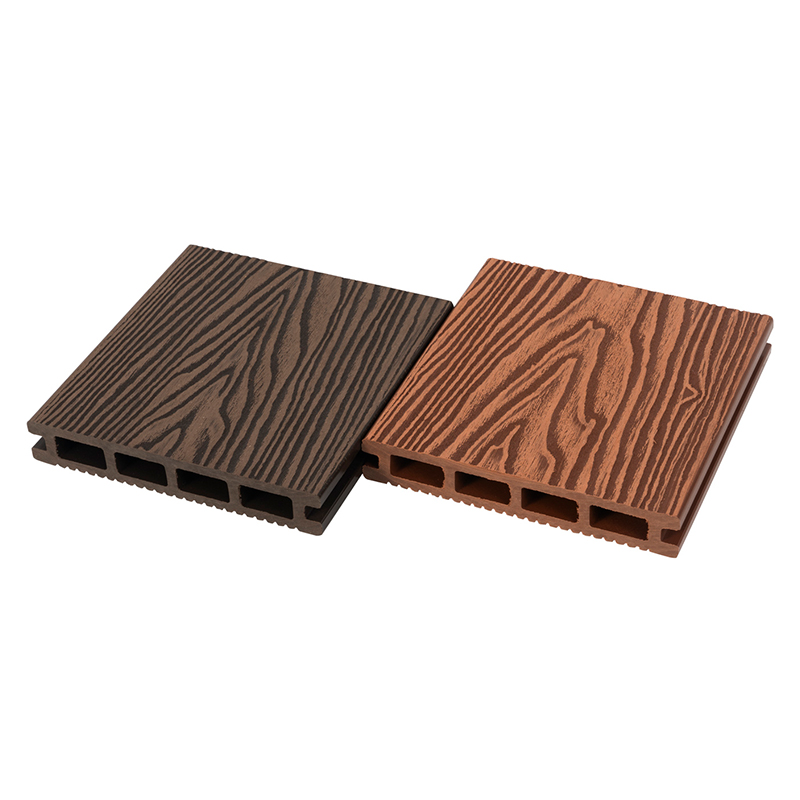
Courtyards experience diverse weather conditions. Rain, morning dew, and pool splashes create serious slipping hazards. Smooth surfaces become dangerous quickly. Evaluating slip resistance requires looking at both physical texture and objective testing metrics.
Water forms a slippery film on flat surfaces. This film causes hydroplaning. Deep 3D embossing disrupts this dangerous process. The varied peaks and valleys break the surface tension of water drops. This disruption allows water to disperse rather than pool uniformly.
The textured valleys channel water away from your feet. The raised peaks provide immediate friction against your shoes or bare skin. This mechanical grip significantly reduces slipping risks. It makes the surface much safer for active families and enclosed courtyard spaces.
You should never guess about safety. Always ask manufacturers for objective evaluation criteria. Reliable suppliers conduct rigorous laboratory testing on their products. They measure friction mathematically.
Dynamic Coefficient of Friction (DCOF): This measures slipping resistance while in motion. Look for ratings above 0.42 for wet areas.
Pendulum Test Values (PTV): This simulates a heel striking a wet floor. A PTV score of 36 or higher indicates a low slip potential.
Requesting these specific metrics ensures you buy genuine anti-slip WPC flooring. Avoid suppliers who only offer vague promises about safety.
Many buyers worry about deep grains trapping dirt. They assume organic matter will accumulate and cause slippery mold. This is a valid concern for natural timber. Algae growth frequently turns damp wooden decks into ice rinks.
However, modern composites prevent this issue entirely. The engineered polymer cap is non-porous. Mold spores cannot root into the plastic shield. Mildew might settle on the surface dust, but it cannot penetrate the board. You can simply sweep or wash it away. The capping technology eliminates the biological growth that typically causes slip hazards.
Your courtyard serves as an outdoor living room. The visual appeal matters just as much as structural safety. Achieving a natural look requires sophisticated manufacturing techniques.
Early composites suffered from an ugly, reflective plastic sheen. They looked like cheap vinyl under direct sunlight. Modern 3D embossing solves this aesthetic problem.
Advanced pressing techniques create a low-gloss, matte finish. The heated rollers impart random, non-repeating patterns across the board. The grooves mimic the organic imperfections of natural hardwood perfectly. You get the visual warmth of real timber. You completely avoid the artificial glare of older polymer boards.
Courtyards see heavy patio furniture movement. Dining chairs drag backward constantly. Heavy planters get pushed across the deck. Smooth-finish composites highlight every single surface abrasion. Even minor scuffs become highly visible.
Deep wood grain WPC decking handles this abuse much better. The varied texture visually breaks up minor scratches. Small scuffs blend directly into the artificial wood grain pattern. The deep embossing hides daily wear and tear. Your courtyard maintains a pristine appearance longer, even under heavy recreational use.
All outdoor materials react to the sun. You must set realistic expectations regarding initial color weathering. During the first few months, composites undergo a natural "settling" period. The initial color may lighten slightly as the board adjusts to direct UV exposure.
Do not panic during this phase. High-quality boards contain advanced UV inhibitors in their polymer cap. Once the initial settling finishes, these chemicals stabilize the aesthetic. The color will remain rich and consistent for the next 10 to 15 years. You will not need to paint or stain the deck to maintain its hue.
Even the highest-quality boards will fail if installed incorrectly. Courtyards present unique micro-climates. You must design the underlying substructure to handle limited airflow and thermal expansion.
Courtyards often feature tall surrounding walls. These walls restrict natural breezes. WPC decking requires adequate ventilation beneath the boards to prevent extreme heat buildup. Without airflow, the boards can warp or cup over time.
You must maintain minimum ground clearance requirements. Most manufacturers demand at least 50mm to 100mm of open space beneath the joists. This gap allows ambient air to circulate. It prevents moisture from getting trapped against the concrete slab. Proper ventilation protects the structural integrity of your deck.
You cannot cut corners on the substructure frame. 3D embossed boards have specific load-bearing limits. This is especially true for hollow profile boards. The deep surface grooves slightly reduce the overall core thickness in certain spots.
Standard joist spacing usually requires centers between 350mm and 400mm. You must strictly adhere to these limits. Stretching the joist spacing to 450mm or 500mm to save money will cause catastrophic failure. The boards will sag under foot traffic. Always follow the manufacturer's maximum span guidelines.
Face-screwing ruins the realistic wood grain aesthetic. It leaves ugly holes and invites moisture penetration. You should always use hidden fastener systems instead.
Concealed clips slot neatly into the grooved edges of the boards. They secure the deck directly to the joists invisibly. Furthermore, these clips enforce mandatory expansion gaps. Plastic expands when heated. You typically need 3mm to 5mm gaps between each board. The clips measure this spacing automatically. They allow safe thermal movement for your outdoor embossed decking without buckling.
Always double-joist where board ends meet. Never share a single clip across two board ends.
Ensure a slight gradient on the concrete slab beneath the deck to promote water drainage.
Leave adequate perimeter gaps where the deck meets courtyard walls to accommodate seasonal expansion.
You must evaluate potential products carefully before making a final decision. Do not rely entirely on online photos. The physical characteristics dictate long-term success.
Order physical samples from at least three different manufacturers. Once they arrive, conduct practical tests at home. First, wet the sample thoroughly with a spray bottle. Press your thumb down firmly and slide it forward. You should feel significant resistance.
Next, grab a hard metal object like a coin or a house key. Run the edge firmly across the grain. Observe how the polymer cap handles the pressure. A premium cap will resist gouging. Finally, examine the cut ends. Ensure the core looks dense and uniform, without excessive air bubbles.
You will need to choose between solid and hollow boards. This choice impacts both weight and durability. The deep 3D embossing process requires a dense substrate. A weak core will compress during manufacturing.
Solid vs. Hollow Embossed Boards | ||
Feature | Solid Board Profile | Hollow Board Profile |
|---|---|---|
Weight & Density | Significantly heavier. Dense core structure. | Lighter. Uses less raw material. |
Embossing Depth | Supports extremely deep, aggressive textures easily. | Limited depth to prevent crushing the hollow chambers. |
Best Application | High-traffic commercial spaces or heavy patio furniture areas. | Light-traffic residential areas. Budget-conscious projects. |
Read the guarantees very carefully. Do not assume a "25-year warranty" covers everything. Manufacturers usually separate their promises into different categories.
Look for the structural warranty first. This covers rot, severe splintering, and fungal decay. Next, read the stain and fade warranty. This specifies how much color loss is legally acceptable. A strong fade warranty guarantees the board will not shift beyond a specific Delta-E color rating. Understanding these distinctions prevents unpleasant surprises a decade later.
Upgrading your courtyard requires pragmatic decisions. 3D embossed composite decking offers the ideal middle ground. It perfectly balances the engineered safety of modern polymers with the visual warmth of natural wood. The deep thermocompressed texture drastically improves slip resistance in wet conditions. The polymer capping ensures the wood-grain aesthetic survives years of intense UV exposure and heavy foot traffic.
To move forward successfully, take these immediate next steps:
Calculate your exact courtyard square footage and map out the underlying ground drainage.
Determine if you need solid boards for heavy furniture or if hollow boards suit your foot traffic.
Order physical samples from shortlisted manufacturers to test localized lighting and wet-friction performance yourself.
A: Yes, plastics retain more heat. Darker wood grain WPC decking will be noticeably warmer under bare feet in direct sunlight; recommend lighter colors for unshaded courtyards.
A: Routine sweeping and bi-annual cleaning with a non-metal stiff bristle brush, mild soap, and water. High-pressure washing is generally discouraged to protect the polymer cap.
A: Solid boards are recommended for high-traffic areas and heavy furniture, as the deep 3D embossing process requires a dense substrate to prevent structural compromise.


